Loading

Building Operational Excellence in Islamic Banking and Finance

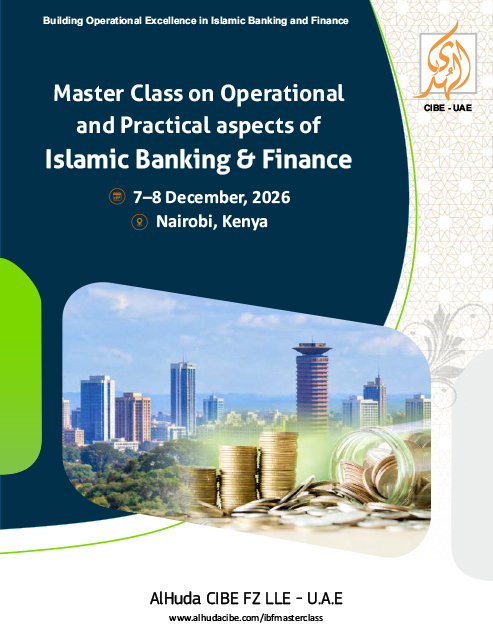
Master Class on Operational and Practical aspects of
Islamic Banking & Finance

7–8 December, 2026
(Nairobi, Kenya)

Building Operational Excellence in Islamic Banking and Finance

Master Class on Operational and Practical aspects of
Islamic Banking & Finance

7–8 December, 2026
(Nairobi, Kenya)

Event Summary

About AlHuda CIBE

AlHuda Centre of Islamic Banking and Economics (AlHuda CIBE - UAE) is a pioneer Organization that has been promoting Islamic Banking and Finance since 2005. Over the years, AlHuda CIBE has gained international recognition for its professional services and dedicated team working to advance Islamic finance through education, research, advisory and capacity building.

AlHuda CIBE provides a range of services including:
  • Advisory & Consultancy
  • Research & Product Development
  • Education & Capacity Building
  • Shariah Advisory
  • Audit, Review & Certification
  • In-house Training & Exposure Visits
  • Publications and Events
More details are available at www.alhudacibe.com

About the Master Class

This two-days master class is designed to develop practical understanding of the operational foundations, products and implementation considerations of Islamic banking and finance. Participants will explore how key Islamic financing contracts are structured and applied in financial institutions, alongside introductory perspectives on Takaful and Islamic microfinance.

The program combines conceptual explanations with operational examples, product comparisons and interactive discussion. It is intended for banking professionals, Islamic finance practitioners, regulators, insurers, microfinance professionals and other stakeholders interested in the practical development of Shariah-compliant financial services.

About Kenya

Kenya is an important financial hub in East Africa and has an established banking and insurance sector. The country's financial-sector framework includes the Central Bank of Kenya (CBK) for banking supervision and regulation and the Insurance Regulatory Authority (IRA) for insurance supervision. Kenya's regulatory framework also includes provisions relevant to the operation of Takaful and Islamic financial services.

Kenya's engagement with Islamic finance also has an international dimension. The Central Bank of Kenya joined the Islamic Financial Services Board (IFSB) as an Associate Member in 2019 and has participated in Islamic-finance-related surveys, conferences and knowledge initiatives.

Benefits of Attending

By attending this master class, participants will be able to:
  • Understand the foundations and operating principles of Islamic banking and finance.
  • Differentiate major Islamic financing products and their contractual structures.
  • Gain practical insight into the implementation and documentation of Islamic banking products.
  • Understand introductory Takaful models and their differences from conventional insurance.
  • Explore the conceptual framework and characteristics of Islamic microfinance.
  • Identify opportunities and key challenges in developing Islamic banking and finance.
  • Engage in case-based learning and professional knowledge sharing.

Building Operational Excellence in Islamic Banking and Finance

Master Class on Operational and Practical aspects of Islamic Banking & Finance

Master Class Contents

Comprehensive 8-Session Outline on Islamic Banking, Finance, Takaful & Microfinance

SESSION 1: INTRODUCTION TO ISLAMIC ECONOMICS, BANKING AND FINANCE

  • Introduction to the Islamic economic and financial system
  • Fundamental principles and objectives of Islamic banking and finance
  • Prohibition of Riba, Gharar and Maysir in financial transactions
  • Differences between Islamic and conventional banking systems
  • Role of Islamic banking in financial inclusion and economic development
  • Global development and emerging trends in Islamic banking and finance

SESSION 2: ISLAMIC BANKING PRODUCTS AND FINANCING MODES

  • Introduction to major Islamic banking products and financing structures
  • Murabahah: Concept, structure, documentation and practical applications
  • Salam and Istisna: Applications in agriculture, manufacturing and trade finance
  • Ijarah: Leasing structures and operational requirements
  • Musharakah and Mudarabah: Partnership-based financing arrangements
  • Diminishing Musharakah: Applications in housing and asset financing
  • Comparative analysis of Islamic financing modes and conventional financing products

SESSION 3: OPERATIONAL AND PRACTICAL ASPECTS OF ISLAMIC BANKING

  • Practical implementation of Islamic banking products
  • Islamic banking deposit mobilization and investment accounts
  • Customer onboarding and financing application procedures
  • Islamic financing documentation and contractual requirements
  • Asset ownership, transfer of risk and transaction execution
  • Profit calculation, pricing mechanisms and payment schedules
  • Common operational challenges and practical solutions in Islamic banking

SESSION 4: SHARIAH GOVERNANCE, COMPLIANCE AND RISK MANAGEMENT

  • Introduction to Shariah governance in Islamic financial institutions
  • Role and responsibilities of Shariah Supervisory Boards
  • Shariah compliance requirements for Islamic banking products
  • Shariah review, audit and monitoring procedures
  • Credit, liquidity, market and operational risks in Islamic banking
  • Identification and management of Shariah non-compliance risks
  • Practical case studies on Islamic banking operations and Shariah compliance

SESSION 5: INTRODUCTION TO TAKAFUL AND ITS PRACTICAL APPLICATIONS

  • Introduction to Takaful and its fundamental principles
  • Differences between conventional insurance and Takaful
  • Overview of Takaful models: Wakalah, Mudarabah and Hybrid
  • Takaful operational structures and fund management
  • Contributions, claims management and surplus distribution
  • Shariah governance and compliance in Takaful operations
  • Opportunities and challenges for Takaful development in emerging markets

SESSION 6: ISLAMIC MICROFINANCE — CONCEPTS, MODELS AND OPERATIONS

  • Introduction and conceptual framework of Islamic microfinance
  • Characteristics and objectives of Islamic microfinance
  • Differences between conventional and Islamic microfinance
  • Islamic microfinance products and financing methodologies
  • Applications of Murabahah, Qard Hasan, Salam and Musharakah in microfinance
  • Role of Islamic microfinance in poverty alleviation and financial inclusion
  • Operational challenges and sustainability of Islamic microfinance institutions

SESSION 7: POTENTIAL AND CHALLENGES FOR THE DEVELOPMENT OF ISLAMIC BANKING

  • Growth potential of Islamic banking and finance in Africa
  • Opportunities for Islamic banking development in Kenya and East Africa
  • Regulatory and institutional considerations for Islamic financial services
  • Challenges in Islamic banking product development and implementation
  • Human resource development and capacity-building requirements
  • Digital banking, FinTech and innovation in Islamic financial services
  • Strategies for expanding Islamic banking and financial inclusion

SESSION 8: PRACTICAL CASE STUDIES AND INTERACTIVE DISCUSSIONS

  • Practical case study on Murabahah financing transactions
  • Practical examples of Islamic banking product documentation
  • Comparative analysis of Islamic and conventional financing transactions
  • Case discussion on Takaful operations and Islamic microfinance
  • Identification of common operational and Shariah compliance challenges
  • Interactive discussion, experience sharing and questions and answers

Who should attend this Training?

  • Banking and financial services professionals
  • Islamic banking practitioners and product-development teams
  • Conventional banks exploring Islamic banking products
  • Shariah advisory, audit and compliance professionals
  • Regulators, policymakers and financial-sector supervisors
  • Insurance and Takaful professionals
  • Microfinance institutions and financial inclusion practitioners
  • Risk management, operations and internal audit teams
  • Academics, researchers, students and development organizations

Speaker & Methodology

Mr. Muhammad Zubair

Managing Director, AlHuda CIBE FZ LLE – UAE
Islamic Finance Expert

Delivery Methods & Fee

  • Lectures / Slide Show / Multimedia Presentations – 70%
  • Class Discussions and Experience Sharing / Q&A – 20%
  • Case Studies, Individual / Group Exercises – 10%
  • Participation Fee: USD 495
  • Includes training sessions, tea/coffee, lunch, study materials and Certificate.
Contact Info
contact us
AlHuda CIBE FZ LLE - U.A.E (Advisory, Consulting & Capacity Building) P.O. Box 120867, Dubai, United Arab Emirates.