Loading

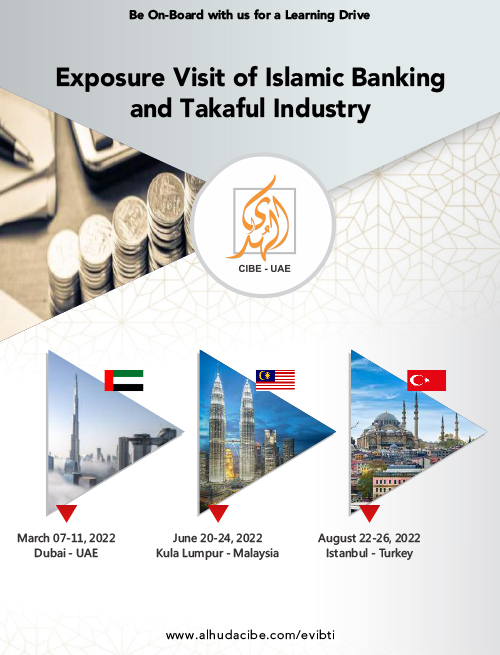
Exposure Visit and Executive Training on

Islamic Banking, Takaful and Islamic Microfinance

April 21 - 24, 2026 - Dubai, UAE

Exposure Visit and Executive Training on

Islamic Banking, Takaful and Islamic Microfinance

April 21 - 24, 2026 - Dubai, UAE

Event Summary

About AlHuda Center of Islamic Banking & Economics

Towards the pursuance of our goal to promote Islamic Banking and Finance all over the globe, AlHuda Centre of Islamic Banking and Economics is working diligently since 2005. AlHuda CIBE has been acknowledged as a distinguished service provider due to our notable services, team of dedicated professionals and one stop solutions of Islamic Banking and Finance. Our aim is to provide state-of-the-art services of Islamic banking and finance. We are proud to be prominent for our Advisory and consultancy, research and development, education and capacity building, Shariah advisory, publication and events all over the world.

AlHuda CIBE is supported by many national and international organizations and institutions as Strategic Partners support and our Alumni have spread over 104 countries. We are proud to stand among world's largest presences for capacity building, trainings, consultancy and other services. More details are available at www.alhudacibe.com

AlHuda Services:

We offer the following services in the field of Islamic Banking and Finance:

• Advisory & Consultancy
• Education, Training & Capacity building
• International conferences and workshops on Islamic finance
• Research and Islamic Financial Product Development
• Shariah Audit and Advisory
• Publications

About Islamic Finance Industry

The global Islamic finance industry expected to reach a total of USD 5 trillion in assets in 2025, reflecting steady growth year-on-year across 56 countries, primarily in the Middle East, South Asia, and Southeast Asia. Iran, Saudi Arabia, and Malaysia continue to dominate the Islamic finance market in terms of asset size. Meanwhile, countries such as Cyprus, Nigeria, and Australia experienced the fastest growth. In terms of Islamic Finance Development Indicators, Malaysia, Bahrain, and the UAE remained the leading countries among the 131 assessed, excelling in areas such as Quantitative Development, Knowledge, Governance, Corporate Social Responsibility, and Awareness. Notable emerging Islamic finance markets that made significant strides in enhancing their financial and supporting ecosystems include Iraq, Suriname, Nigeria, and Ethiopia. A growing number of Islamic financial institutions continue to operate globally, contributing to the expanding reach of the sector.
Digitalization has become a key driver of transformation within the Islamic finance industry, mirroring its profound impact on the global financial system. This trend is revolutionizing various sectors of Islamic finance, offering increased efficiency, accessibility, and innovation in services. The integration of digital technologies is enhancing financial inclusion, enabling the development of more sophisticated financial products and services, and improving overall customer experiences.
Considering the performance across different sectors of the Islamic finance industry, alongside the development of the supporting ecosystem, there is considerable potential for the industry to expand further. It is projected that by 2026, the total assets of the Islamic finance industry could reach USD 6 trillion, driven by ongoing innovation and digitalization efforts.

About Exposure Visit:


Exposure visit is a tool that is used to facilitate the professionals’ learning through interactive industry visits. The exposure visit involves two or more parties where one is learning from the other. It promotes issues of good practices and a process of building on underlying concepts. Our arrangements for exposure visit will assist the professionals to be inculcated by the practical knowledge of different segment of Islamic finance industry; which involves Islamic banking, Takaful, Islamic leasing, Sukuk, Islamic Fintech and other Islamic financial markets exposure. It also will include Islamic Finance education provider top ranked university.

The Exposure Visit Program: A Learning Revolution

AlHuda CIBE’s Exposure Visit program is a unique initiative designed to provide hands-on learning through a mix of on-site training and off-site experiential learning. This innovative approach ensures participants gain practical knowledge while exploring global best practices in Islamic finance.

Program Features

On-Site Training

  • Industry Visits: Witness real-world practices at leading Islamic financial institutions in Dubai.
  • Expert Engagements: Meet industry leaders, Shariah scholars, and regulatory experts to discuss market trends and challenges.
  • Interactive Sessions: Participate in discussions on Shariah compliance, risk management, and product development.

Off-Site Learning

  • Workshops: Explore thematic issues like Islamic Banking and Finance operation mechanism, Fintech, Sukuk structuring, and Takaful innovation.
  • Case Studies: Analyze successful Islamic finance models and their global applications
  • Networking Galas: Build connections with peers and industry leaders during elegant evening events.

Cultural Immersion & Infotainment

  • City Tours: Experience Dubai rich cultural and economic landscape through guided visits to iconic landmarks.
  • Social Networking: Enjoy a gala dinner, fostering informal interactions and cultural exchange.

Training Contents

Exposure Visit and Executive Training on Islamic Banking, Takaful and Islamic Microfinance

A Glance on Islamic Banking and Finance

  • Riba and Prohibition of Riba
  • Economics Rationale for Free Prohibition of Riba
  • Development of Islamic Banking and Finance
  • AAOIFI, IFSB and its role
  • Challenges and Opportunities in Islamic Banking Industry

Shariah Foundation and Applications of Islamic Banking and Finance

  • Conceptual Framework of Islamic Banking and Finance
  • Islamic Banking and Finance Characteristics
  • Sustainability outreach and Problems pertaining to microfinance system
  • Future Prospect and Way Forward for Sustainable Industry Growth
  • Role of IFB in Boosting Financial Inclusion

Islamic Finance Products

  • Islamic Banking Products mechanisms
  • Operational Aspects of Islamic Banking and Islamic Microfinance Products
  • Partnership Based Islamic Banking (Mudarabah & Musharakah) Products
  • Trade Based Modes of Islamic Banking (Murabahah, Salam, Istisna etc.)
  • Rental Based Products of Islamic Banking (Ijarah & Diminishing Musharakah)
  • Application of Islamic Microfinance Products

Introduction & Recent Developments in Takaful

  • Fundamental Principles of Takaful
  • Reference in first constitution of Madina
  • Judicial opinions and Fatwas

Takaful Models

  • The Mudaraba Model
  • The Wakala Model
  • The Waqaf Wakala Model
  • Investment Models

Islamic Microfinance

  • Incidence of Poverty and Low Economic opportunity
  • Conceptual Framework of Islamic Microfinance
  • Islamic Microfinance Characteristics
  • Sustainability outreach and Problems pertaining to microfinance system

Regulation & Governance: Role of Shariah Board

  • Comparative regulation of IFSI
  • Islamic Finance, Islamic financial institutions (IFI) and
  • Islamic Financial Services Industry (IFISI)
  • Essential considerations for regulation and governance
  • Regulatory framework for Shariah supervision
  • Governance framework for Shariah supervision
  • Impact of regulation and governance on compliance behavior
  • Supervisory/regulatory role of the Central Bank (Main Functions)
  • Islamic banking widow / branch of a conventional bank
Contact Info
contact us
AlHuda CIBE FZ LLE - U.A.E (Advisory, Consulting & Capacity Building) P.O. Box 120867, Dubai, United Arab Emirates.